
You do not need a data science department to know if your AI is helping. You need clear goals, simple tests, and a routine for checking results. Treat AI like any other product feature.
Define success in plain language
Pick one outcome that matters and write it down.
- Reduce time to draft a response
- Increase first contact resolution
- Improve search answer acceptance
- Cut manual handoffs per ticket
Attach a number and a time frame. For example, improve answer acceptance from 60 percent to 80 percent in four weeks.
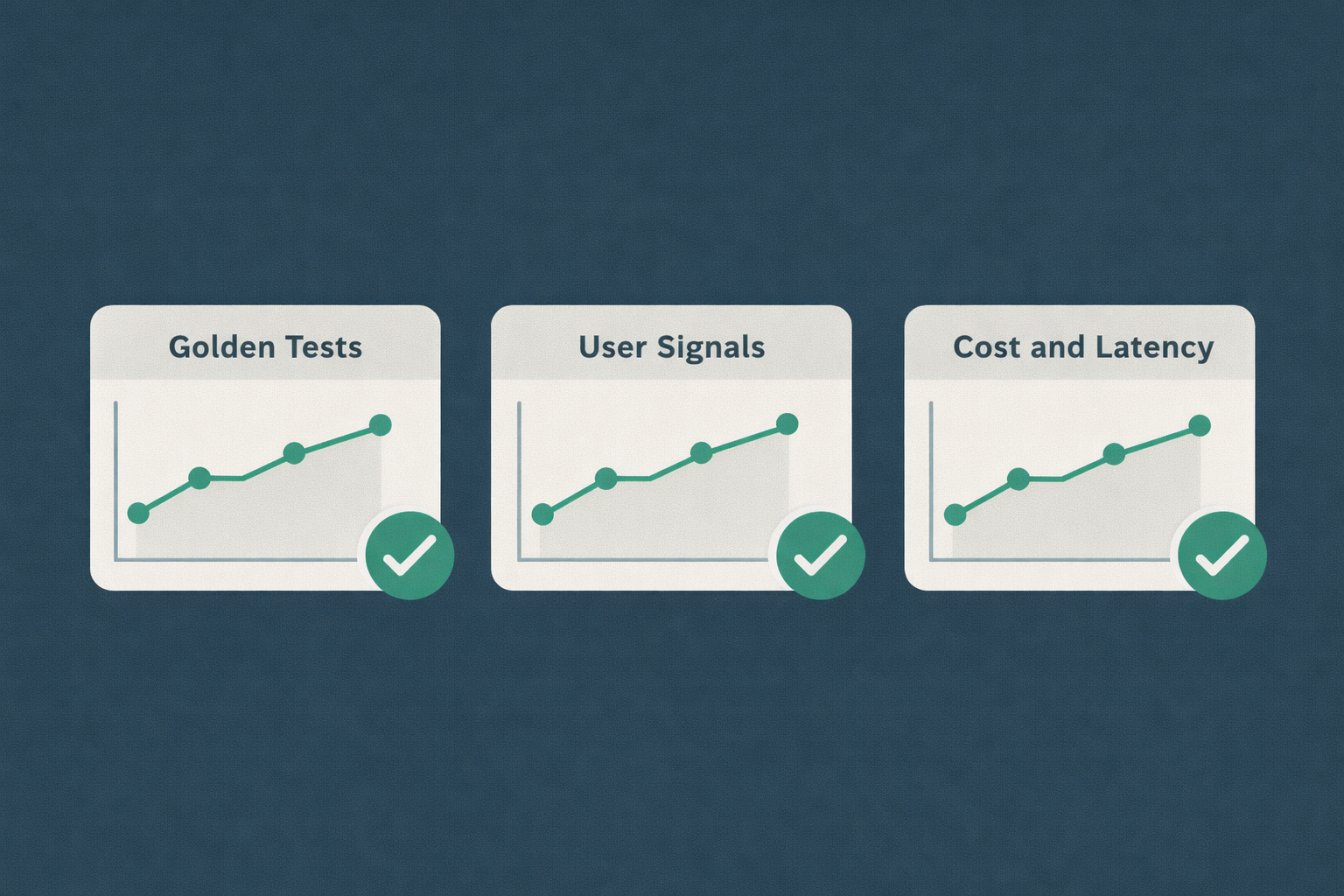
Create golden test cases
Build a small set of real examples that never changes.
- 20 to 50 representative prompts or questions
- Known good answers written by your team
- Edge cases and common traps
Run every new prompt change against this set and record pass or fail.
Score what users actually see
Collect simple quality signals from production.
- Thumbs up or down on each answer
- Time to first useful answer
- Edit distance from draft to final message
- Escalation rate to human experts
Use weekly trend lines, not one day spikes.
Check grounding and citations
If your AI cites sources, verify them.
- Each answer must link to a real document
- Links must open and match the claim
- Flag answers with missing or broken citations
Reject answers that cannot prove where the facts came from.
Watch for safety and compliance
Block obvious risks early.
- Redact PII and secrets in logs
- Limit access to internal content by role and team
- Add a rate limit per user and per integration
- Keep prompts and responses for audit only as long as needed
Build a lightweight evaluation loop
Keep it simple and repeatable.
- Daily: scan errors and top negatives
- Weekly: review quality metrics with owners
- Biweekly: update golden tests and fix bad prompts
- Monthly: decide to expand, pause, or roll back
Use small experiments
Change one thing at a time.
- New model, same prompts
- New prompts, same model
- Retrieval settings A vs B
Ship to a small group behind a feature flag before rolling out.
Cost and latency belong in quality
Great answers that arrive too slowly or cost too much still fail.
- Track cost per action
- Track p50 and p95 latency
- Set budgets and alerts
Quality is not a mystery. With clear goals, golden tests, simple user signals, and regular reviews, any team can evaluate AI with confidence. If you want a practical scoring plan and dashboards you can run without a data team, ping us at Code Scientists.